Common Product Sense Questions (2026 Edition)
Introduction: Navigating the Ambiguity of 2026
In the modern hiring landscape, product sense remains the ultimate differentiator. I define it as the fundamental ability to make high-quality decisions under conditions of extreme ambiguity. While AI has automated much of the traditional execution and "vibe coding" has made building cheaper, the human element of judgment is now the primary bottleneck. To succeed, you must demonstrate intense user empathy. This is the ability to simulate how different people will react to a product, even when those users are nothing like you.
The State of the Market: Why Product Sense is the Great Filter
The interview landscape in 2026 is brutal. FAANG pass rates for this round hover between 20% and 30%. Interviewers are no longer just checking if you can follow a template. They are calibrating for "Product Taste," a high-bar signal that separates the "Hires" from the "Strong Hires." To see where you stand, you can use tools like PracticeLoop AI to run through these scenarios with an AI interviewer.
Structured thinking used to be the ceiling for PM performance. Today, it is the baseline. Interviewers look for genuine strategic awareness and the ability to articulate why a specific solution belongs in the market. If your answer sounds like a generic list of features, you will likely receive a "No Hire" recommendation.
Core Category: Improving Existing Products
These questions test your ability to navigate the constraints of established platforms. You are tasked with finding new avenues for growth or engagement while respecting existing customer expectations. High-frequency prompts include:
- How would you improve Instagram Reels for the 18 to 24 year old demographic?
- How would you improve the shopping experience on Instagram?
- How would you improve Spotify for college students?
- How would you improve Facebook Events to increase RSVPs and attendance?
Expert Tip: When improving existing products, do not just list features. Focus on identifying a specific gap in the current user journey or a shift in the market that the product has yet to address.
Core Category: Designing for the User
Empathy-led design prompts require you to build for specific, often underserved, populations. This tests your ability to translate unique physical or social needs into requirements.
- Design a car for blind people.
- Design a product for first-time parents.
- Design a product for senior citizens to stay connected with family.
Key Principle: The User is Never a Monolith Segmentation is mandatory. You must divide users into subsets based on behavioral traits or contexts. When designing for seniors, for instance, you must differentiate between tech-savvy individuals and low-tech seniors who face higher anxiety around new interfaces.
Core Category: Zero-to-One AI Products
The shift to AI-native thinking has birthed a new class of questions. Success requires AI product sense, the ability to understand what models can and cannot do.
- Design an AI assistant for remote workers.
- Build a product for small business owners in emerging markets using AI.
- Design an AI tutor for underserved schools.
A generic "I would use AI to personalize it" is a failing signal. You must discuss how the AI specifically solves a root problem, such as overcoming creator block.
The 2026 AI Edge: Vibe Coding and the Meta AI Round
The Meta interview has evolved into the "Meta AI Round." This is a 60-minute session split into 30 minutes of traditional product sense followed by 30 minutes of prototyping.
A critical skill here is vibe coding. This is the ability to translate product requirements into working prototypes using natural language prompts within AI tools. Because building is now inexpensive, your judgment during the prototyping phase is more important than your ability to code manually. Because these rounds are now 50% prototyping, practicing with a simulated AI interviewer on PracticeLoop AI can help you master the necessary 30/30 time split.
Expert Tip: Do not spend your 30 minutes on UI polish. The signal is in your prompting strategy and how you handle technical trade-offs like latency and token usage. After you build, expect follow-ups in three specific buckets:
- Technical AI: Optimizing for compute power and retrieval.
- Prompting Strategy: Ensuring the most efficient use of tokens.
- Product Thinking: Incentivizing users to provide better data for recommendations.
The Master Framework: A 6-Step Approach
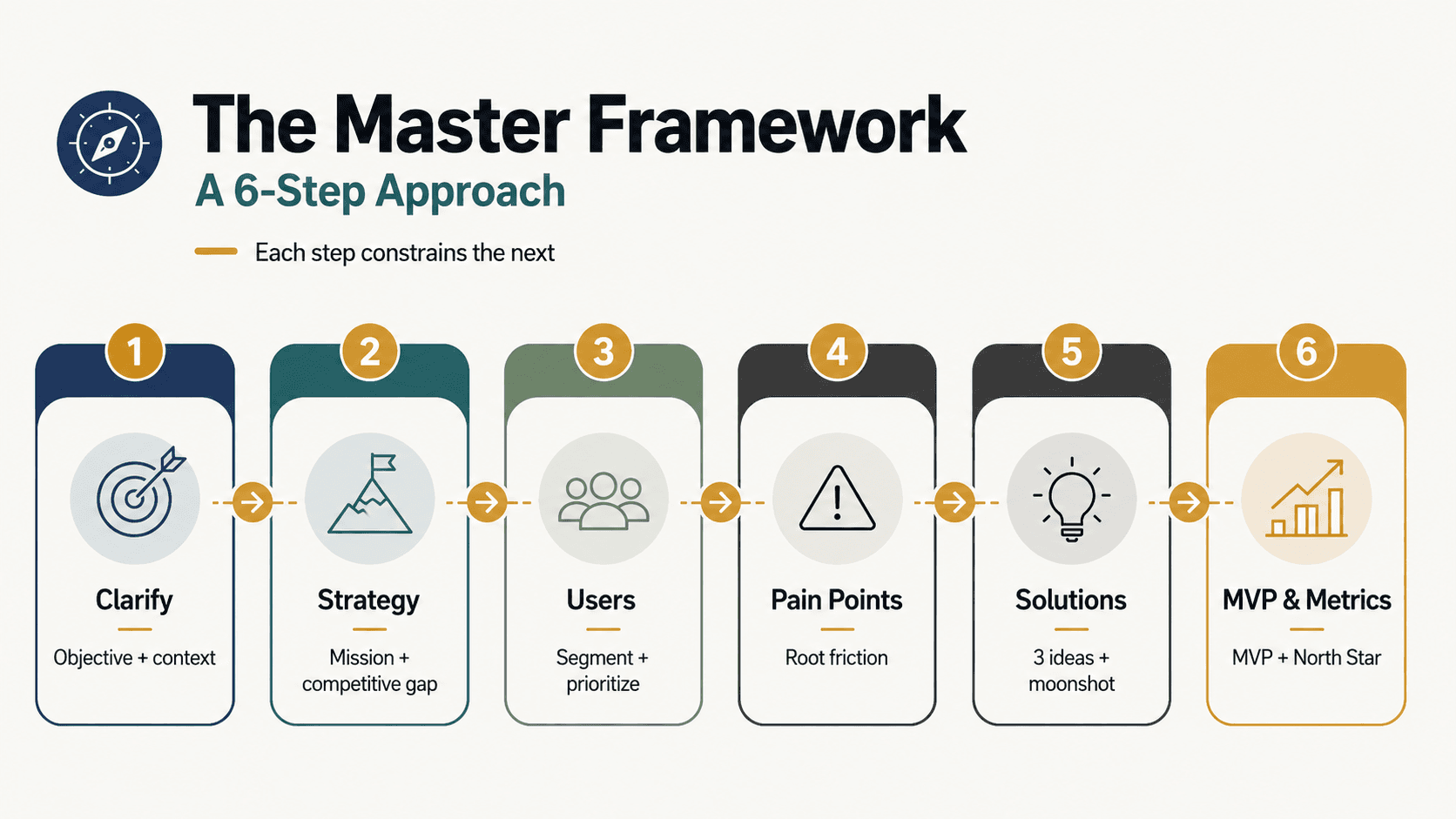
Apply these six steps to any prompt. Each step constrains the next.
- Clarify: Define the objective and gather essential context. Ask questions that will actually change what you build.
- Strategy: Align with the company mission. For Senior candidates, you must explicitly name the competitive gap and the longer product arc.
- Users: Identify specific segments and prioritize one based on market size or severity of need.
- Pain Points: Dig into the root friction. Use buckets like time, money, and motivation to ensure points are distinct.
- Solutions: Brainstorm at least three meaningfully different ideas. Include a "moonshot" to demonstrate vision.
- MVP & Metrics: Define the smallest version that delivers value. Identify a primary North Star and guardrail metrics.
Frequently Asked Questions (FAQ)
What is the difference between product sense and design? The evaluation criteria are nearly identical. However, product sense focuses more on the "why" and strategic awareness. It tests your judgment in ambiguous situations, while design often looks closer at interaction details.
How long should my answer be? Aim for 30 to 35 minutes for the core content. This allows time for the interviewer to probe trade-offs and constraints.
Do I need to be technical for AI rounds? You do not need to be a developer. However, you must demonstrate "Architectural Logic" and "Visual Fluency." You need to understand concepts like latency, token usage, and retrieval. Crucially, you must narrate your choices live as you prototype to show the interviewer your decision-making process.