How to Prepare for a Product Sense Interview in 2026
The 2026 Shift: Navigating the New AI Bar
In 2026, the product sense interview has moved from testing "what" you build to "why" you build it. Because generative AI tools have made execution nearly free, the industry bottleneck has shifted from shipping code to product judgment. I expect you to speak the language of engineering leaders; if you cannot articulate a retrieval strategy or a fallback plan for model regression, you do not have product sense in this market.
The most visible change is the rise of vibe coding. Leading companies like Meta, Google, and Stripe now use live prototyping rounds. You are handed tools like Cursor, Bolt, or Lovable and given 45 minutes to direct an AI to build a working demo of your product vision. This is not a coding test; it is a test of whether you can review AI output critically and ship a functional artifact of your strategic thinking.
Technical Depth and Verification
Simply suggesting "we'll use AI to personalize the feed" is an automatic "No Hire." You must demonstrate fluency in:
- Hallucination mitigation: Defining how you maintain model reliability in high-stakes actions.
- Retrieval: Explaining how the system utilizes specific data (RAG) to ensure accuracy.
- Token/latency tradeoffs: Balancing compute costs and UX speed—specifically how you optimize for the "Aha!" moment without breaking the bank.
Interviewers now use technical verification to expose surface-level knowledge. If you mention an AI project, be prepared for the F1 score question. They are verifying if you actually understood the implementation or just read a PRD. One deeply-known story beats five shallow ones every time.
The Evolution of the 6-Step Framework
In 2026, a structured response is no longer an advantage; it is the floor. Use this evolved framework to signal mastery.
- Clarify: Ask 2+ questions to define technology and constraints. Use the "Heuristic of Two Directions": "If the answer to the technology constraint is X, I will go in direction A. If it is Y, I will go in direction B." This tells me you aren't just stalling; you're scoping.
- Strategy: Align with the company mission. At OpenAI, this means the AGI mission; at Meta, it means connecting people. Identify the competitive gap that makes this opportunity exist right now.
- Users: Segment the audience using Mutually Exclusive, Collectively Exhaustive (MECE) logic to show you've explored the entire space.
- Pain Points: Identify root causes using the four critical buckets: Time, Money, Motivation, and Trust/Safety. If your pain points all fall into one bucket, you haven't found three problems; you've found one problem with three faces.
- Solutions: Brainstorm through specific "Product Cuts" to ensure variety: AI/Software, Hardware/Physical, Platform/Network, Ambient/Environmental, and Moonshot.
- MVP: Define the smallest valuable version. Be ruthless about what gets cut. Specific deprioritization signals judgment; vague "we'll A/B test it later" signals avoidance.
The Masterclass: MECE 5-Minute Segmentation Method
Effective segmentation makes your final target feel "inevitable." You must show coverage before you zoom in.
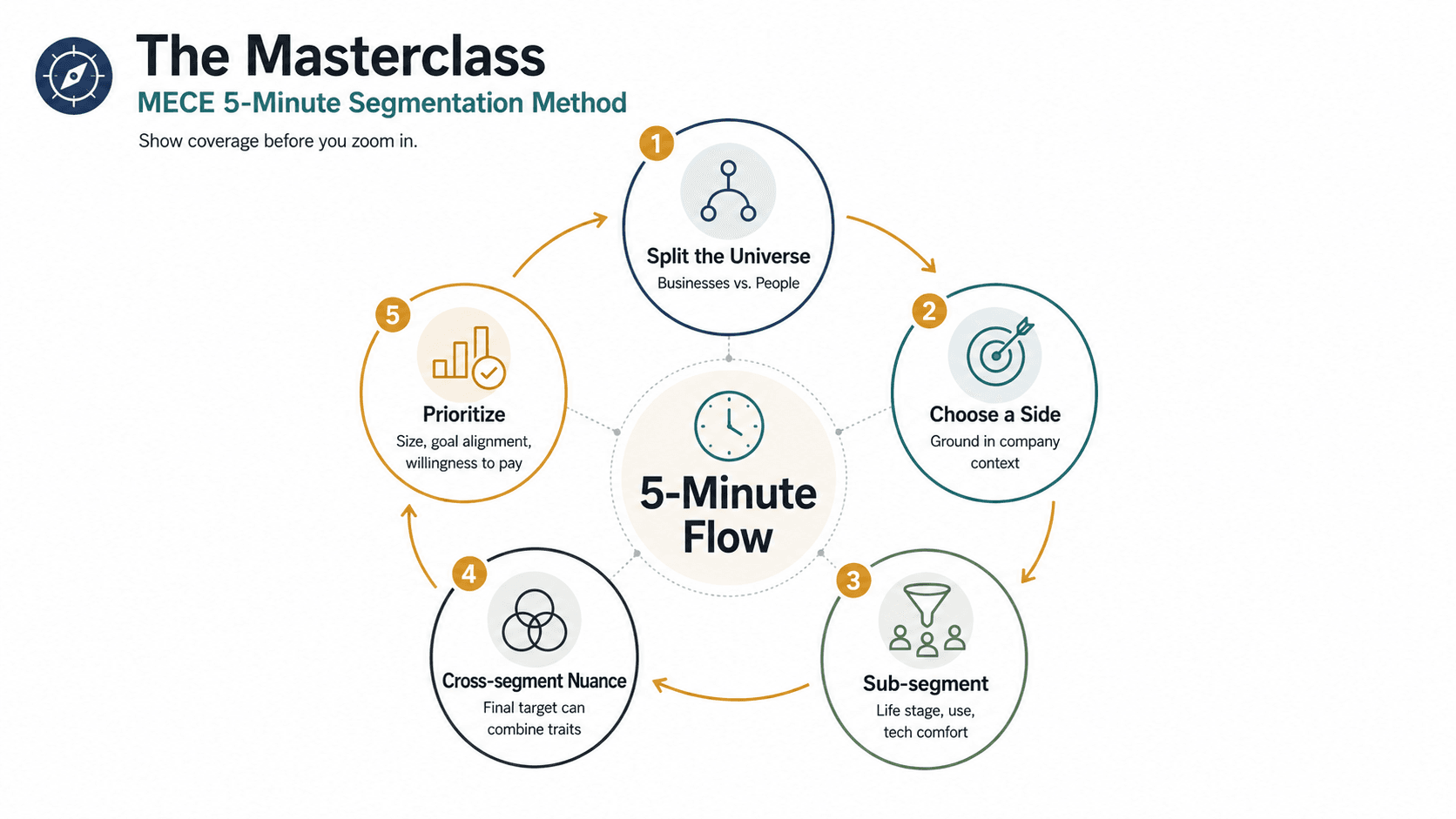
The 5-Minute Flow
- Split the Universe: Divide the ecosystem into Businesses vs. People. This prevents you from missing obvious stakeholders like providers in a marketplace.
- Choose a Side: Ground this in company context. If you are at a B2B powerhouse, target the business side unless the prompt dictates otherwise.
- Sub-segment: Use need-relevant criteria—life stage, intensity of use, or tech comfort.
- Cross-segment Nuance: While your base segmentation should be MECE, your final target can be a cross-segment (e.g., "Individual professional with high urgency").
- Prioritize: Use "interview-friendly" criteria: size, alignment with the business goal, and willingness to pay.
Company Nuance: Culture as a Strategic Filter
Product taste is relative to the logo on the building. You must filter your sense through their specific business model.
Meta (The Connector)
At Meta, every solution must tie back to "connecting people." You will be tested on guardrail metrics. When faced with a curveball—like notification engagement rising while time on site falls—use the Clarify, Enumerate, Prioritize sequence:
- Clarify: What exactly does "engagement" mean here? (e.g., clicking vs. just reading).
- Enumerate: List external (seasonality), internal (UI shifts), and measurement (data bugs) factors.
- Prioritize: State which hypothesis you'd test first and why.
Netflix (The Informed Captain)
Netflix operates on the informed captain model, where individual PMs lead through consumer science (A/B testing and data-backed intuition). This decentralized decision-making is critical as they chase high-stakes targets, such as their $3B ad-revenue goal. Your answers here should reflect a rigorous focus on retention and monetization.
| Feature | Meta | Netflix |
|---|---|---|
| Core Mission | Connecting People | Consumer Science / Entertainment |
| Model | Social Ecosystem | Informed Captain |
| Decision Model | Integrated/Metric-Driven | Decentralized/Captain-Led |
| Metric Focus | Guardrail Metrics | Retention & $3B Ad-Revenue Targets |
The Prep Math: Tactical Readiness
Success is a function of volume and specific practice.
- Time: 4–8 weeks of consistent, dedicated study.
- Mocks: 10+ mock interviews practiced out loud. Speaking your thoughts is different than thinking them.
- Clarification: Data shows candidates asking 2+ clarifying questions have a 2x higher close rate.
FAQ: Avoiding the "No Hire" Pitfalls
Why is generic segmentation a red flag? Using "casual vs. power users" tells me nothing about the problem. It is a description of engagement, not a person. Use need-relevant attributes like "low-tech seniors" or "insurance-constrained patients" to show you've pictured a real person.
What is the "Three-as-One" trap? Listing anxiety, guilt, and fear as three separate pain points is a mistake. If one product feature (like a notification) solves all three, they are not distinct. Find different root causes across the Time, Money, Motivation, and Trust buckets.
Can I rely on frameworks? CIRCLES and other frameworks are scaffolding, not scripts. If you sound like you are reciting a 2023 bootcamp script, you will fail on "Product Taste." Deep follow-ups are designed specifically to break canned answers.
Conclusion: From Intuition to Judgment
Product sense is not an innate gift; it is structured judgment. It is the ability to navigate ambiguity and defend what to ship even when the model messes up. To build the "vibe coding" fluency required for 2026, I command you to build a small AI prototype this weekend using Lovable or Cursor. Moving from theory to implementation is the only way to upgrade your behavioral stories and prove you belong at the frontier.