How to Prepare for a Meta Product Sense Interview
Introduction: Empathy Over Equations
I have sat on both sides of the table at Meta as a candidate and as a calibrated interviewer. If there is one piece of advice I can give you as a peer, it is this: stop looking for a math problem.
The Product Sense interview is not a test of your ability to arrive at a single "correct" solution. It is a rigorous evaluation of your logic, your human empathy, and your ability to navigate ambiguity with a structured hand. Meta is not just looking for someone who can build a feature. They are looking for someone who understands why a feature should exist for a person in the first place. You are being evaluated on your thought process and your ability to act as a product architect in a messy, open-ended environment.
The Meta Mindset: Solving "People Problems" for 3 Billion Users
At Meta, our terminology is deliberate. We do not just talk about "use cases" or "jobs-to-be-done." We solve People Problems.
Because Meta's products reach over 3 billion people, the requirement for "Thinking at Scale" is non-negotiable. You cannot solve for a niche; you must solve for broad human needs that resonate globally. Crucially, Meta looks for Facilitators, not "CEOs of the product." Your role is to lead a cross-functional team of Engineering, Design, and Data Science peers. In this interview, prioritize human needs over immediate business goals. Prove you can make the user's life better before you worry about how to monetize it.
Definition: People Problem A "People Problem" is the underlying human need, desire, or friction point that a product aims to solve. It moves beyond "The user wants a button" to "The user feels disconnected and needs a way to build community."
The 45-Minute Breakdown: Respecting the Clock
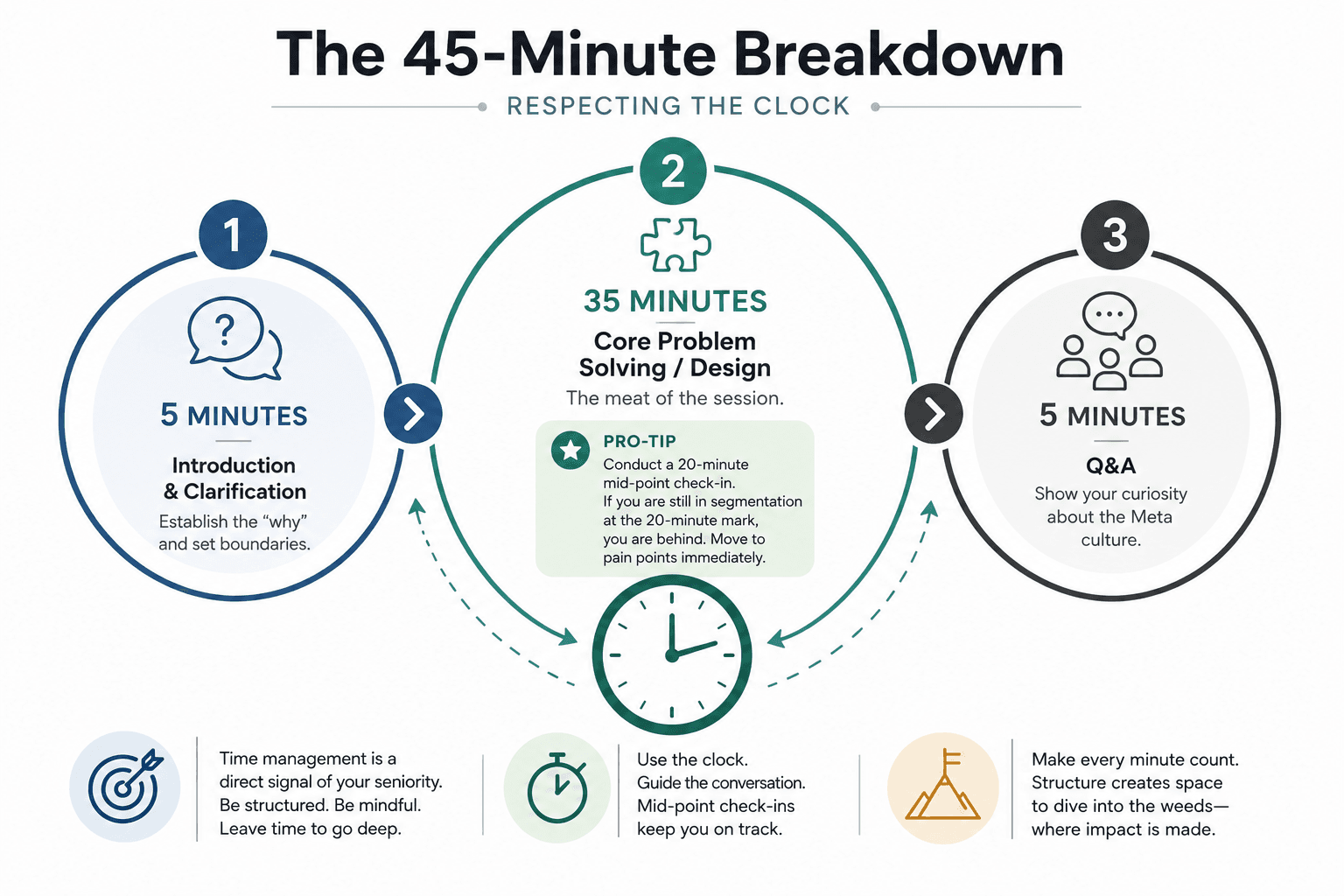
Time management is a direct signal of your seniority. If you meander, you lose the opportunity to "dive into the weeds"—a key Meta requirement. Treat the 45-minute slot with surgical precision:
- 5 Minutes: Introduction and Clarification. Establish the "why" and set boundaries.
- 35 Minutes: Core Problem Solving/Design. The meat of the session. Pro-Tip: Conduct a 20-minute mid-point check-in. If you are still in segmentation at the 20-minute mark, you are behind. Move to pain points immediately.
- 5 Minutes: Q&A. Show your curiosity about the Meta culture.
The Master Framework: A Step-by-Step Tactical Guide
Use this framework to transform ambiguity into a concrete product recommendation.
Clarification: Ask "Why?" Before "How?"
The biggest mistake is searching for a "correct" answer to an unsolved problem. Clarifying questions remove the fog.
- Context is King: Consider the "Fake News" scenario. If an interviewer asks the percentage of fake news on Facebook, don't jump to ML models. Ask who is asking. If the CEO needs an estimate for a report next week, a defensible human-review sample of 5,000 posts is better than a perfect technical definition that takes six months to build.
- Goal Alignment: Is the goal top-of-funnel growth or a down-funnel retention signal?
Mission Alignment & Product Vision
Meta is mission-driven. Every solution must tie back to "giving people the power to build community."
- Vision: State it clearly. "Our vision is to make fitness rewarding and achievable through community support."
- North Star: Anchor your North Star in Meaningful Social Interaction (MSI). A Meta North Star should facilitate connection between people, not just "app opens."
Segmentation: Reach vs. Impact
Use the MECE (Mutually Exclusive, Collectively Exhaustive) principle to segment the user base. To show Meta-level analytical framing, use a Scoring Table to prioritize.
- T-Shirt Sizing: Score your segments (e.g., Beginners, Professionals, Casuals) as Small, Medium, or Large based on Reach (total users) and Underserved Need (how much they currently struggle).
Pain Points: Severity vs. Frequency
Brainstorm 3 to 5 pain points. Prioritize them using the same scoring logic:
- Severity: How much does this hurt the user?
- Frequency: How often does this occur?
- Example: A lack of motivation is a high-severity, high-frequency problem for beginners.
Solution Brainstorming: The MVP Focus
Move from problems to products by focusing on the Minimum Viable Product (MVP).
- Dive into the Weeds: Meta hates "hand-waving." Describe actual UI elements, data flows, or how the API might fetch a feed.
- Trade-offs: Every choice has a cost. Acknowledge why you chose a simple recommendation engine over a complex AI model for the MVP.
Metrics & Success: Measuring What Matters
Define success using industry-standard metrics:
- Engagement: Likes, comments, shares (MSI indicators).
- Retention: The 28-day stickiness of the product.
- Counter-metrics: Ensure your new feature isn't cannibalizing other core products.
Strategic Waypointing: Guiding Your Interviewer's Scorecard
Your interviewer is following a competency-based rubric. Help them fill out their scorecard by "waypointing" or signposting your process. Narrate your transition between sections so they don't miss your signals.
Communication Best Practices:
- Framework Signposting: "To evaluate Execution, I'm going to look at these three trade-offs."
- The Pause: "I've prioritized beginners because they offer the highest reach. Does that alignment work for you?"
- Visualization: Verbally "whiteboard" the data flow. "The client will call this API endpoint to retrieve the personalized community feed."
The Mock Interview Advantage: Building Muscle Memory
The best way to build this muscle is through repetitive mock interviews. Tools like PracticeLoop AI allow you to simulate these high-pressure sessions with an AI interviewer before you face the real thing. Repetition turns a rigid framework into a natural, high-level conversation.
Common Traps: Where High-Performers Falter
Even senior leads can fail if they lose sight of the Meta rubric.
- Jumping to solutions too quickly. You must define the People Problem first.
- Ignoring trade-offs. If you do not acknowledge what you are giving up, you are not thinking like a Product Architect.
- Searching for the correct answer. The unsolved nature of the problem is the point. If there were a simple correct answer, Meta would have built it already.
- Meandering without structure. Time is a signal of seniority.
- Staying too high level. You must dive into the weeds of the product architecture.
- Ignoring Meta's scale. Solutions that only work for a tiny niche will not pass the bar.
Conclusion: Final Bootcamp Wisdom
When you land the offer, your first 4 to 6 weeks at Meta will be "Bootcamp." It is a period of intense cultural immersion where you learn to move fast. Treat your interview like a mini-version of that experience. Hypothesize, summarize, and recommend like you are already in a Meta boardroom. Be tactical, be empathetic, and keep your focus on the community. You have got this.
FAQ
What does it mean to be "unallocated"? Meta often hires PMs into a general pool. You join "unallocated" and spend your first weeks in Bootcamp meeting different teams to find a mutual match.
How long is the actual core problem-solving session? The core design and problem-solving portion lasts exactly 35 minutes within a 45-minute interview slot.
What is the "Product Sense with AI" round? This is a variation focused on AI-native features—think proactive recommendations, content discovery, or generative tools—rather than just adding a chatbot. It tests how AI solves the People Problem more efficiently.
Should I focus on business goals or people problems? In this round, you must prioritize People Problems. Meta wants to see your ability to empathize with the human need before discussing the business outcome.
Is there a "correct" solution to the case? No. We evaluate your structured thinking, trade-off analysis, and your ability to handle ambiguity. Two candidates can propose opposite solutions and both get a "Hire" if their reasoning is sound.