How to Ace the AI Product Sense PM Interview: The Ultimate Prep Guide
The High-Stakes World of AI Product Management
The AI product management job market has entered a phase of unprecedented intensity and reward. Top-tier firms like OpenAI, Anthropic, and Meta are actively headhunting for roles that redefine the traditional compensation ceiling; staff-level packages now routinely range from $300,000 to well over $800,000. In this hyper-competitive landscape, the "Product Sense" interview has evolved into the primary filter for high-value roles. It is no longer enough to manage a roadmap: candidates must demonstrate an ability to navigate the complex, non-linear challenges inherent in large-scale AI deployment. Senior candidates often fail not because they lack talent, but because they lack the calibration required for these specific loops.
To ground your mindset for these interviews, you must internalize the staggering real-world scale and financial velocity of the industry:
- OpenAI's Scale: Within its 800 million weekly active users (WAU), image creation specifically accounts for 175 million WAU. A common interview challenge is to strategize how to scale that specific feature to 350 million WAU within a single quarter.
- Claude's Revenue Trajectory: Tools like Claude Code have reached a $2.5 billion run rate. That's a 25x revenue jump in just over a year.
- Iterative Velocity: Leading teams are shipping over 70 features per quarter, requiring PMs who can manage rapid iteration cycles without compromising safety.
Succeeding at this scale requires more than just a background in software; it demands a fundamental shift in how you approach product design and execution.
The Core Shift: From Deterministic to Probabilistic Thinking
Traditional PM frameworks fail in AI interviews because they were built for a "deterministic" world. In standard software, a user clicks a button and a predictable, hard-coded event occurs. However, senior candidates frequently struggle because they fail to account for the "probabilistic" nature of AI. When dealing with large language models, the output varies every time; the system can hallucinate, cost real dollars for every query, and require safety as a core constraint rather than a secondary consideration.
The following table evaluates the critical contrasts you must acknowledge during your interview:
| Deterministic PM | Probabilistic PM |
|---|---|
| Predictable clicks and hard-coded logic | Non-deterministic outputs and hallucinations |
| Linear user journeys and fixed features | Model-based behavior and compute latency |
| Optimizing for clicks and engagement | Designing guardrails and ethical boundaries |
| Low marginal cost per user action | Real-world dollar costs per output token |
This shift forces PMs to move from simply "designing features" to "designing guardrails" and managing the safety boundaries within which a model operates. Your role is to ensure that while the model is probabilistic, the product experience remains reliable for the user.
Advanced Frameworks: The Game Framework and the 3-Layer Model
To structure a 45-minute interview effectively, elite candidates use the Game Framework (Goals, Actions, Metrics, Evaluation). However, the "Actions" and "Evaluation" phases must be nested with technical depth using the 3-Layer Model for AI Product Sense. This synthesis proves you can handle both product goal-setting and complex ML architecture.
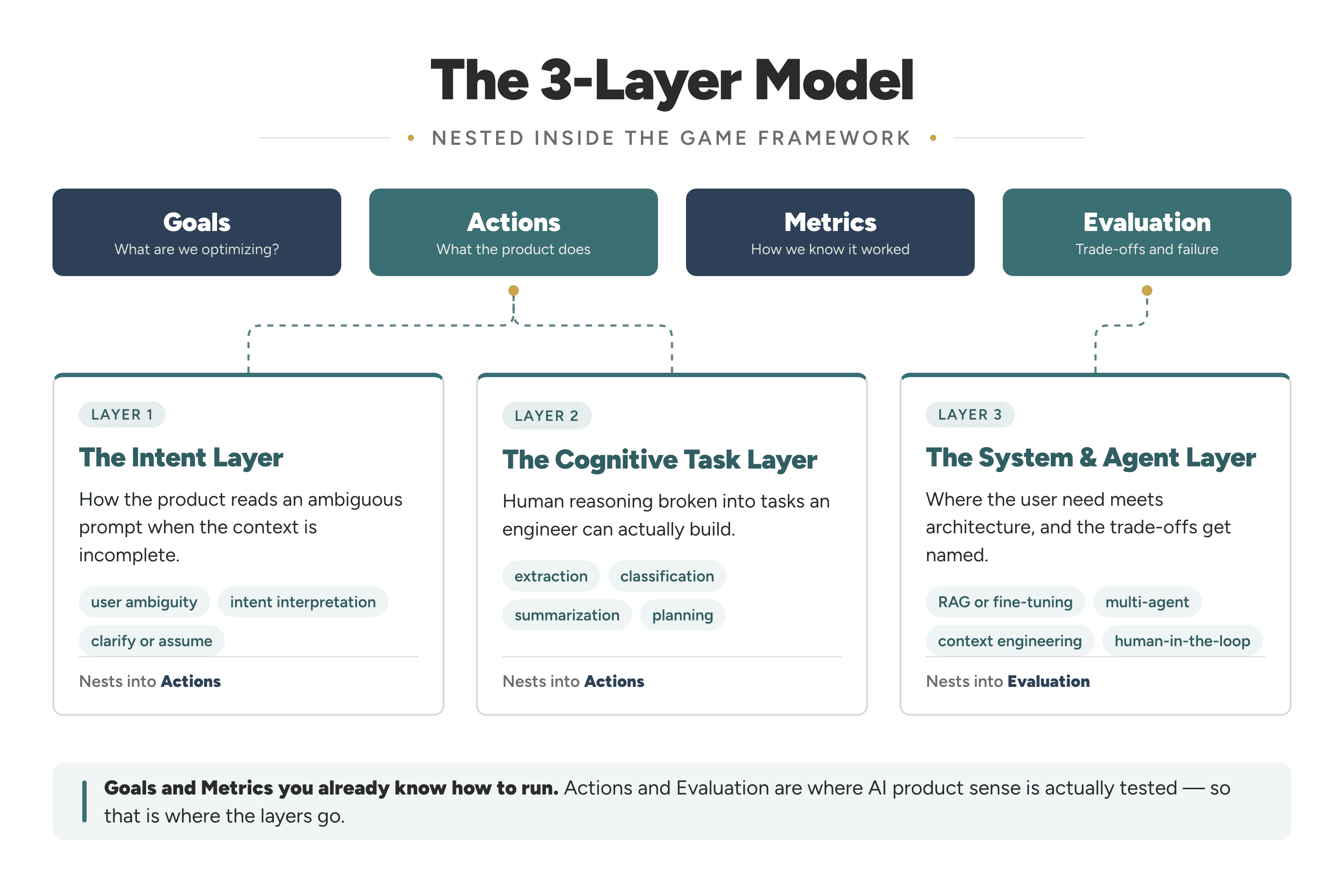
Layer 1: The Intent Layer
Nest this within your Actions phase. This layer focuses on how the product navigates user ambiguity and incomplete context. You must define the intent interpretation logic: does the model ask clarifying questions or make a best-guess assumption? In an AI-first product, the PM decides how the system interprets a prompt to align with unstated user goals.
Layer 2: The Cognitive Task Layer
Replace basic user stories with a decomposition of human reasoning into specific tasks: extraction, classification, summarization, and planning. For example, if designing an AI financial analyst, the "task" isn't "analyze data"; it is "extract data from 50 PDFs, classify it into spreadsheet rows, and plan a comparative summary." This allows the engineering team to understand the exact cognitive functions required.
Layer 3: The System & Agent Layer
Link user needs to architecture during your Evaluation of trade-offs. You must discuss the nuances of RAG (Retrieval-Augmented Generation) versus fine-tuning, implementing multi-agent systems, and context engineering. A critical component here is the human-in-the-loop checkpoint: determining when a model's output requires a person to verify the results to maintain trust.
While these frameworks provide structure, Meta and Anthropic specifically look for the "Human Delta" in your execution.
Mastering the Human Delta and Strategic Leverage
The concept of the "Human Delta" is central to modern AI PM interviews. In an era where AI can generate basic outlines, those tasks are "table stakes." To stand out, you must demonstrate strategic leverage by offloading lower-level tasks to the model while focusing 90% of the interview on high-stakes trade-offs, engineering pushback, and failure states.
Identifying the Strategic Lever
At Anthropic, a key strategic lever for growth is reaching non-developers. While Claude Code targets engineers, Claude Cowork targets the "Knowledge Automator." Consider the Stephanie persona: a senior financial analyst who manually pulls data from 50 PDFs every quarter to create comparison tables. Identifying such underserved, high-reach segments is where the PM provides value that the model cannot.
Competitive Landscape Analysis
You must evaluate differentiators between models using analytical rigor:
- OpenAI's Multimodal Strength: Focus on the integration of image generation into the existing 800 million user chat ecosystem to drive immediate WAU growth.
- Anthropic's Safety Principles: Leverage the 3 H's (Helpful, Honest, Harmless). For an AI Well-being Companion for the Elderly, safety is not a feature: it is a constraint. You must design the product to limit "over-engagement" and prevent the AI from creating a false sense of companionship that replaces real human relationships.
Highlighting these trade-offs leads naturally into the hard economics of running an AI business.
AI Economics: Token Unit Economics and Failure Design
In a resource-constrained environment (e.g., three engineers and a three-month timeline), your "Build vs. Buy vs. Fine-tune" decisions are strategic survival choices. You must articulate the economic implications of your product decisions.
Token Economics
Candidates should demonstrate a grasp of unit economics by:
- Differentiating Input and Output Costs: Understanding that generating tokens (output) is significantly more expensive than reading them (input). Designing features to minimize "output token" bloat is essential to protecting margins.
- Token Efficiency as a Competitive Advantage: Cite the market's current frustration (e.g., Reddit-led critiques of Claude's token usage) versus the OpenAI Codex CLI's efficiency.
- Evaluating Marginal Costs: Calculating the real dollar cost per query compared to traditional software margins.
Failure Design
AI will fail; the goal is to manage that failure. Address the "Confidently Wrong" problem (hallucination) by designing fallback experiences. This includes graceful degradation — where the system provides a simpler, safer output when confidence is low — and providing clear confidence scores to notify the user of uncertainty.
Bridging the Gap: Calibration and Vibe Coding
Theory is a liability if it is not calibrated through high-fidelity simulation. Reading about AI PM loops is not enough: you must perform. This is why top candidates use tools like PracticeLoop AI to refine their performance. PracticeLoop AI simulates realistic AI interviewer interactions, allowing you to get the calibrated feedback necessary to pass at a senior PM level.
Vibe Coding
Modern Meta and Google interviews now include Vibe Coding rounds. This is not a request for you to write code; it is a live whiteboarding, prototyping and prompt engineering exercise. You are expected to vibe code live, using modern tools like Lovable or Cursor to demonstrate how you would direct the AI to build a feature. Showing the "Human Delta" means being able to prototype a functional experience in real-time by directing the model with precision.
FAQ: Navigating Common Interview Pitfalls
These final questions often differentiate the L5 candidate from the L7 hire.
Can I still use the CIRCLES framework? No. CIRCLES assumes a linear, deterministic journey. It fails to account for model-based behavior or the agentic workflows inherent in AI products. Use the Game Framework nested with the 3-Layer Model instead.
How much technical ML knowledge do I need? You do not need to code a loss function, but you must understand the inner workings. This means discussing how agents are based on models, the impact of latency on UX, and how model policies act as guardrails for non-deterministic design.
Why does Meta look for the "Human Delta"? Meta focuses on high-level decision-making. They want to see how you handle the "messy" parts of AI (safety, ethics, and engineering pushback) that the AI cannot yet solve autonomously.
How do I handle the speed/cost vs. accuracy trade-off? Present this as a deliberate product decision. For creative brainstorming, prioritize speed and low cost. For medical or financial data extraction, prioritize accuracy and model quality, even if it increases latency and output token costs.
To stand out in the current market, focus on the probabilistic nature of the technology and demonstrate that you can manage the model as a teammate, not just a tool. Stand out by embracing the uncertainty.