Product Sense Interview Frameworks: The Elite Coach's Playbook
Introduction: Decoding Product Sense
In the high-stakes world of FAANG hiring, "Product Sense" is where most candidates drown in their own notes. This isn't a creativity test; it is an evaluation of your ability to navigate ambiguity to find product-market fit. Product sense is the bridge between deep user empathy and overarching business strategy.
If you can't signal structured judgment here, you're done. This stage accounts for 30–40% of the total weight in PM interview loops. Most candidates fail because they treat frameworks like a compliance form or a safety blanket. To the hiring committee, "script dependence" is a bad signal. It suggests you need training wheels to solve real problems. We use frameworks as a "judgment scaffold": a structure to guide the conversation without dictating it like a robotic script. Your goal isn't box completion; it's user insight.
The Gold Standard: Mastering the CIRCLES Method
The CIRCLES Method is the foundational scaffold for product design questions (e.g., "Design X for Y"). Created by Lewis Lin, it ensures you cover every aspect of product thinking, but only if you use it like a jazz musician uses sheet music—reference it, don't just recite it.
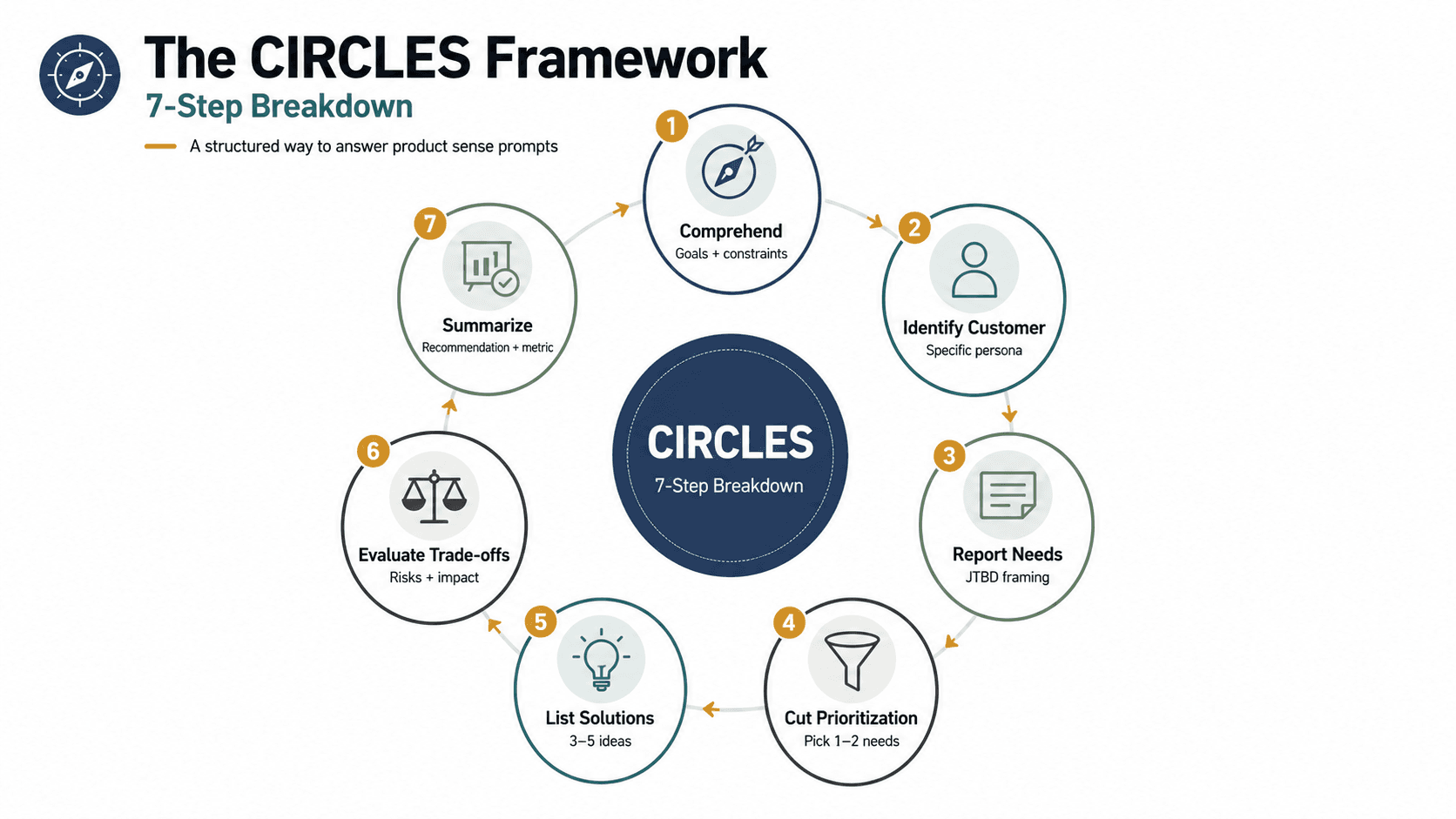
The CIRCLES Step-by-Step Breakdown
- C — Comprehend the Situation: Clarify goals, constraints, and context. Don't ask questions to stall; ask to define scope. Are we looking for engagement, revenue, or stickiness?
- I — Identify the Customer: Define specific personas. Avoid generic buckets like "all users." High-signal candidates pick a segment like "part-time Uber drivers over 45 who drive to avoid isolation." Specificity is judgment.
- R — Report Customer Needs: Frame pain points using Jobs-to-be-Done (JTBD). Use this template: "When I [situation], I want to [motivation], so I can [outcome]."
- C — Cut through Prioritization: This is the "Senior PM" signal. Most candidates fail here by trying to solve everything. Use a decision spine to pick 1–2 needs. Be explicit about what you are killing and why.
- L — List Solutions: Brainstorm 3–5 diverse, non-obvious ideas. One should be a "moonshot," and another should be a grounded, high-impact feature.
- E — Evaluate Trade-offs: This is the core of the interview. Analyze second-order effects, technical risks, and second-order impact. Compare your solutions to pick a winner.
- S — Summarize Recommendation: Provide a clear conclusion. State the recommended solution, the target user, and the metric that proves it moved the needle.
Elite Coach Pro-Tip: If you spend five minutes reciting the acronym, you've already failed. The first three steps (Comprehend, Identify, Report) should be crisp—ideally around 90 seconds total. This buys you time for the "meat" of the interview: the Trade-off Analysis. Top candidates "bend" or even drop the framework once the structure is established to show they are responsive to the interviewer's curveballs.
The 12-Minute Game Clock
If you can't manage your clock, you can't manage a product. Target this pacing:
- Comprehend: 30 seconds
- Identify Customer: 60 seconds
- Report Needs: 60 seconds
- Cut/Prioritize: 90 seconds
- List Solutions: 3 minutes
- Evaluate Trade-offs: 3 minutes
- Summarize: 60 seconds
The PM Toolkit: Beyond CIRCLES
CIRCLES is for design, but a battle-hardened PM needs a broader arsenal. Note that some frameworks are "chameleons"—their meaning changes based on the round.
| Framework | Primary Use Case | Strategic Value |
|---|---|---|
| HEART | UX Metrics (Google Artifact) | Measures Happiness, Engagement, Adoption, Retention, Task Success. Use to prove you care about experience quality. |
| RICE | Quantitative Prioritization | Reach × Impact × Confidence ÷ Effort. Neutralizes gut feelings by penalizing speculation through the "Confidence" score. |
| AARM (Funnel) | Metrics Rounds | Acquisition, Activation, Retention, Monetization. The classic health check for user lifecycle and growth mechanics. |
| AARM (Technical) | Amazon/Systems Rounds | Action, Acceptability, Risk, Management. Used to evaluate technical feasibility and what breaks under load. |
| STAR Method | Behavioral Stories | Situation, Task, Action, Result. The only way to structure past leadership stories without rambling. |
| Pirate Metrics (AARRR) | Growth Analysis | Focuses on the user lifecycle from top-of-funnel to revenue and referral. |
Strategic Application: Navigating Company "Operating Systems"
Interviewers don't just judge your answer; they judge your cultural alignment. You must adapt your framework to the company's specific "Operating System."
- Google: Emphasize analytical rigor. Google values "metric hygiene." Use the HEART Framework—treat metrics as hypotheses, not just KPIs. If you don't define success metrics for a Google Ads improvement, it's an instant "No Hire."
- Amazon: Focus on "Customer Obsession" and long-term durability. Amazon uses PRFAQs in real life; your interview should mirror that. When listing features, you must proactively identify "Undesired Consequences" and "Risks to Customer Trust." Use the Technical version of AARM to evaluate what might break.
- Meta: Prioritize behavioral insight and growth mechanics. Meta wants a "chain of reasoning": Behavior → Intervention → Shift in User Psychology. Don't just list features; explain how a feature leads to a measurable change in human motivation. Use CIRCLES, but link it to User Empathy.
Tactical Mastery: Execution Tips and Pitfalls
Winning the interview requires total control over your delivery.
Avoid These Failure Modes
- "Feature Vomit": Listing 10+ shallow features to look creative. It actually signals a lack of prioritization. Three well-thought-out, prioritized solutions beat ten shallow ones every time.
- Ignoring Edge Cases: Senior PMs don't just talk about the "happy path." Proactively mention technical feasibility, risks, and second-order effects.
- Script Dependence: If the interviewer introduces a constraint (e.g., "Assume we have no engineering resources for six months"), and you can't pivot because it's not in your framework, you've shown you can't handle a real-world roadmap.
Frequently Asked Questions (FAQ)
Should I name the framework? Briefly naming it (e.g., "I'll use the CIRCLES scaffold to structure this") signals structured thinking. But don't let the acronym dominate the narrative. The best candidates use the structure so naturally that the interviewer forgets they're using a framework at all.
How many frameworks do I need to know? Master 4–5 core scaffolds: CIRCLES (Design), HEART (UX Metrics), RICE (Prioritization), AARM (both versions), and STAR (Behavioral).
What if I don't know the industry well? Ask sharp clarifying questions and make reasonable, stated assumptions. Interviewers care about your chain of reasoning, not your domain expertise.
What if I get stuck? Fall back on your "North Star": User Empathy. Ask yourself: "What is the primary Job-to-be-Done here?" If you anchor your thinking in the user's struggle, you will always find your way back to a structured solution.
Final Call to Action
Moving from "memorizing" to "internalizing" these frameworks takes about 15-20 timed mock interviews. Frameworks are proxies for decision hygiene; they are not answer generators. Your goal in the room is to move from box completion to user insight. Build the muscle of identifying trade-offs and user motivations, and you will navigate even the most ambiguous product sense questions with authority. Now, go practice today at PracticeLoop AI.